


Energy Is the Hydrogen age rising?. Energy Alternatif
Hydrogen or Electricity
Hydrogen seems to be the perfect energy carrier. Everything from heating, moving with a car and chemical processing should be powered by hydrogen. The idea of the hydrogen age is quite old and dates back to 19th century, when the great science fiction writer Jule Verne published 1874 the idea, that in the future, hydrogen will power everything we need."And what will they burn instead of coal?"
"Water," replied Harding.
"Water!" cried Pencroft, "water as fuel for steamers and engines! water to heat water!"
"Yes, but water decomposed into its primitive elements," replied Cyrus Harding, " Jules Verne, The Mysterious Island , 1874 [1]
.jpg/800px-Early_flight_02562u_(3).jpg) |
| Hydrogen was used for the first time to fill balloons (Source: Wikipedia) |
Why are we still in the electricity age?
Electricity seems to be one of the greatest innovations, mankind ever made. Electricity has some advantages, which other technologies do not even come close to. Let me list some of them:
- Speed of light: Electricity travels with the speed of light, and can be transmitted theoretically within a tenth of a second around the globe
- No mass transportation involved: To transport electricity, we don't need to build trucks, railways or ships, because there is no mass during transportation present
- Almost no conversion loss: To convert electricity into mechanical energy there is almost no loss, the efficiency in a modern electric motor is significantly higher than 90%
- Multiple applications: Motion, light, information processing, heat, chemical reaction, sound, and unlimited other applications can be driven by electricity
- No emission: This is a statement about electricity itself, not about the production of electricity.
- Simple distribution even to the smallest applications with simple wires
- No risk of explosion
Although the list of advantages is impressive, there is a hard problem remaining with electricity, and this is storage!
We have seen 100 years of research, but only a limited number of efficient storage concepts for electricity are available. Bulk storage is covered by pumped hydro systems, converting electrical energy into gravitational potential energy with a high efficiency of 80% during a roundtrip. Pumped hydro is therefore the absolutely preferred technology, when large amounts (GWh) of grid power have to be stored, in simple words 99% of grid storage is pumped hydro based.
Small amounts of electricity in mobile devices from smartphone up to electric vehicles are powered by batteries of different types, preferred Li-Ion batteries.
Here comes Hydrogen
Every new concept of energy carrier needs at least some advantages over the previous one. Hydrogen has a big advantage, it is a storage concept for energy by itself.
One kilogram of hydrogen contains 33 kWh of energy, if it is converted to water and we use the oxygen of the air and don't count the weight of the air. This number is the highest for any chemical, this is three times more energy than one liter diesel contains. But there is a problem, hydrogen is the gas with the least density, useful for balloons and Zeppelins. One liter of hydrogen at normal pressure contains only 0,003 kWh of energy and this is, without any discussion, insufficient for any application.
There are three ways to enhance the energy density of hydrogen per volume:
- Pressurize: Typical modern storage systems have 700 Bar pressure (1,5 kWh/l)
- Liquidity: At a temperature of -252 �C hydrogen gets liquid (2,8 kWh/l)
- Hide in metals: some metals suck up hydrogen in their crystal grid
All these techniques ad some significant weight and cost to the hydrogen and in addition it costs some energy to reach the dense state of the hydrogen. Typical loss is about 10% of the energy by the pressurizatio or cooling process.
In summary, storage of hydrogen is expensive but not prohibitively expensive.
Conversion to Hydrogen
Hydrogen is an energy carrier, not an energy source as often cited. There is just no significant amount of free hydrogen on earth, so hydrogen has to be produced. The standard process of hydrogen production is steam reforming, using natural gas to produce hydrogen. This is by no means a sustainable solution.
To produce hydrogen for a sustainable energy future, it has to be produced with electricity from wind or solar sources. This is possible, but expensive. The core problem is, an electrolytic process, that disintegrates water molecules to hydrogen and oxygen by its very nature produces oxygen. We like oxygen for breathing, but metals don't, they imitatively corrode if oxygen and water are present. To get rid of this problem, we have to use noble metals like platinum or palladium and they are expensive.
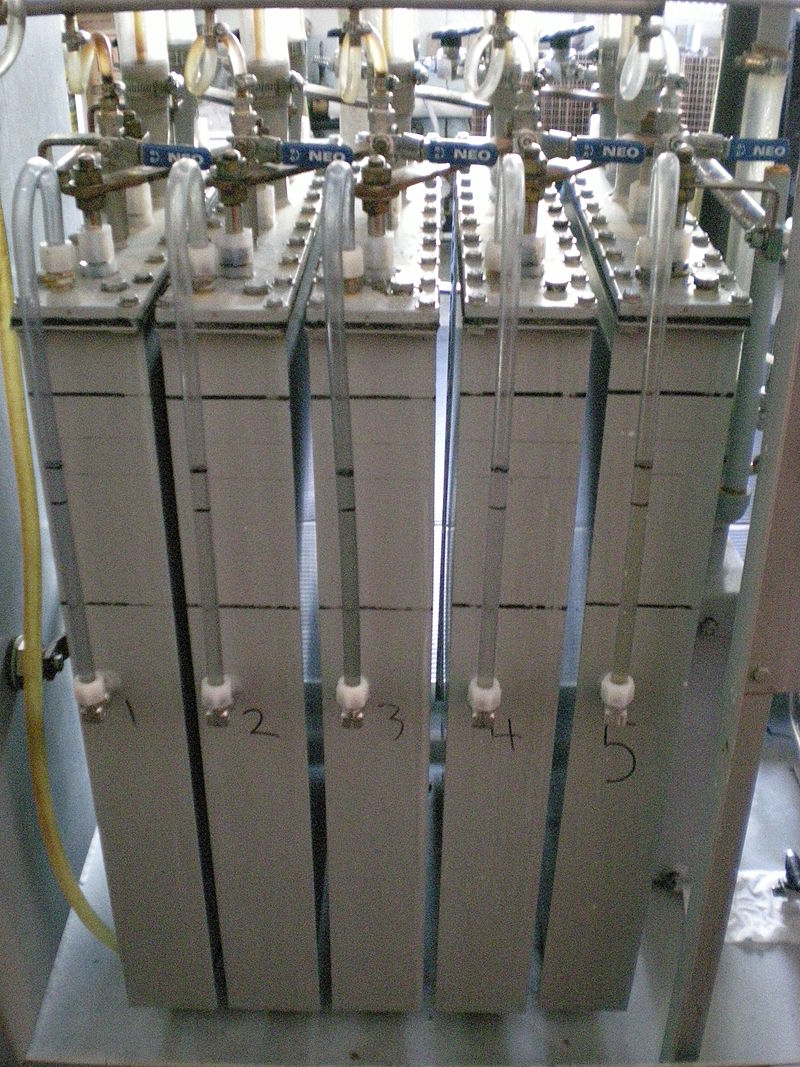 |
| Modern electrolytic cell for hydrogen production (Source: Wikipedia) |
Another big problem is, the conversion of electricity energy into hydrogen comes not without losses. Depending on the details of the process, we end up at 20-30% loss of energy, a significant problem.
Distribution of Hydrogen
Transportation of hydrogen is preferably done by gas pipelines. A well known technology from natural gas, although not with the same efficiency, due to the very low density of the energy in even compressed hydrogen gas. Another problem is, hydrogen is a very small molecule that can travel even trough metal grids, so special care is necessary to use the right materials.
Today, no country has a large hydrogen pipeline grid, resulting in the problem, it has to be built from scratch. And a pipeline grid is very expensive!
Using Hydrogen
At the end of the pipe, hydrogen has to be used in power consuming applications. The simple way to use it, is to burn hydrogen. It generates clean heat, only water is emitted into the air. Sounds perfect, but it doesn't make any sense, because using the electricity that generated the hydrogen could have been used in a radiator, this would be not only more energy efficient, it is also less dangerous.
 |
| Hydrogen engine in a BMW (source Wiki |
Cars can use hydrogen as clean fuel. A slightly modified combustion engine can burn hydrogen, emitting water and some toxic nitrogen oxides, therefore we still need a catalyst at the exhaust pipe.
Another problem is the very low efficiency of a combustion engine, somewhere at 25% of the energy in the hydrogen reaches the road to accelerate the car. Resulting in a very low overall efficiency if we start with electricity. Compare this result to a Li-Ion battery, where about 90% of the energy reaches the road and as a bonus, we can reuse the energy when we brake to charge the battery again!
Another idea is, to convert the hydrogen back to electricity, whenever needed. This is possible, using a fuel cell. The sad thing about this part is, it comes again with high cost due to the expensive precious metals and with more loss of energy during conversion.
Is Hydrogen the Future?
Summing up all this points, today, an electric grid in combination with pumped hydro and batteries in mobile applications seems to be the better solution for the rising age of the renewable energy world.
But there is always research and no one can predict, if there is a breakthrough in technology. But this is not only true for hydrogen technologies, it is also true for batteries, pumped storage, e.g. the Hydraulic Rock Storage seems to be one, and many other technologies.
Comment by Elon Musk to hydrogen
Confusing Hydrogen and Hydrogen
It should be mentioned, that there is a technology of nuclear fusion, using hydrogen to produce nuclear power. This path of research was not very promising till today, although a new interesting path, low energy nuclear reaction, commonly known as cold fusion might be a very disruptive technology, but this is another story.